Language models place little weight on brand-owned content: Stuart Bowden, WPP
Stuart Bowden, President of Strategy and Capabilities for Global Clients, WPP, speaks to e4m on working differently with communities for engagement, distinction between paid and organic, and much more
 by
by
Published: Jun 30, 2026 9:21 AM | 7 min read
 Follow Us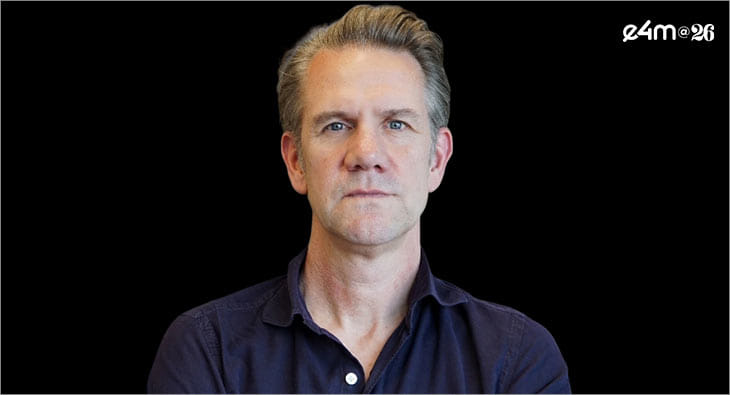

- Client conversations have shifted from a focus on technology to how it can drive meaningful business outcomes, emphasizing the need for brands to build stronger owned and shared ecosystems supported by paid media.
- Research indicates that reallocating budgets from traditional paid social advertising to influencer marketing can yield significantly higher long-term ROI, highlighting the importance of influence over mere media output.
- Brands face challenges in scaling influencer marketing due to fragmented ecosystems and siloed organizational structures, necessitating integrated approaches and new measurement frameworks to effectively engage communities.
- The evolving landscape of discovery, driven by social platforms and AI, requires brands to actively participate in communities to enhance their visibility and influence, as traditional metrics become less relevant in assessing marketing effectiveness.
What are the key capabilities clients are looking for today in a market that is constantly being disrupted?
A big change in client conversations, in the last couple of years, has been a move from just talking about technology and focused on how technology enables meaningful business outcomes. In the past, this has been a struggle to achieve at scale and cost-effectively.
Today, most discussions focus on helping brands move beyond paid media as their primary growth lever to acquire and retain customers. We are encouraging clients to build stronger owned and shared ecosystems, supported by paid media, and use data to create influence at scale.
Research from WPP and industry bodies such as the IPA (The Institute of Practitioners in Advertising) suggests that one of the most effective changes brands can make this year is to move monies out of traditional paid social advertising. The criteria are to hit a certain set KPI and the media output has absolutely no value. Influence is generated across platforms, owned and shared; clients have to build influence to build brands. It has been difficult to scale and our conversations with clients are about working differently with communities for engagement and make the needed transition. Paid media is fragmented and we see a decline in the output over time.
Do you consider influencer marketing to be part of paid media?
The distinction between paid and organic is becoming less important. What matters is influence. We are seeing major brands like Unilever publicly commit to significantly increasing influencer investment, up to 50%, globally.
In reality, achieving scale through purely organic content is rare. We are working with communities where there is a shared interest and communities, with the brand. Most successful influencer strategies combine paid and organic elements. The challenge for global brands has been scaling influencer programs consistently because influencer ecosystems are fragmented across markets, agencies, technologies, and measurement systems. Looking at influencer marketing agencies are largely independent across markets. This is a challenge as each brand manager in each market works with different people, with different KPIs as there is no standard technology and it is not controllable from a brand’s point of view.
Our focus is on building what we call "systems of influence"—using data and technology to identify the right communities, creators, and organic content, driven by a brand’s perspective. These reverse paid media spending and achieve optimized reach and the paid media in social can follow the right organic content that has been built for the brand. Additionally, automating the process so brands can scale influencer marketing globally with confidence.
What role does influencer marketing play compared to traditional paid social advertising?
I would encourage most brands to move as much budget as possible from paid social advertising into boosting influencer marketing. IPA research analyzing hundreds of marketing effectiveness studies found that every euro spent on influencer marketing generates roughly twice the long-term ROI of a euro spent on traditional advertising.
The challenge isn't proving the value—most clients already understand it. The challenge is creating the systems, measurement frameworks, and operational structures that allow brands to scale influencer marketing effectively across markets.
Are silos still a challenge for clients, even as agencies become more integrated?
I absolutely do not underestimate the organisational challenge on the client side. In many organizations, paid social, organic social, commerce, PR, and advertising still sit in separate departments with separate KPIs. When you have individual KPIs for teams they will not deliver what’s needed for the business. Clients understand why WPP made the changes to an integrated WPP set-up. Clients will eventually have to undergo through internal changes and in the interim, we are helping them overcome the silos that exist within their organization.
Which emerging platforms or ecosystems are most exciting right now?
There are over 30 global platforms with more than a billion MAUs (monthly active users), yet most marketing budgets, up to 75%, remain concentrated on just a couple of them.
What's more interesting is not the platform itself but the community it represents. Platforms like Strava, for example, tell you exactly with 100% accuracy what users – fitness enthusiasts - care about. You need to be clear about the brand’s permanent positioning and focused on understanding communities and helping brands become welcomed participants rather than unwanted interruptions. If a brand can genuinely contribute value to that community, it can build influence much more effectively than through interruption-based advertising, which does not interest the TG.
How do you see social commerce evolving globally and in markets like India?
Rather than focusing on labels in functional terms like social commerce or retail media, it's more useful to think about the marketing job that needs to be done.
Brands need to create discovery opportunities, generate new demand, and establish new usage occasions. Brands will always need to be discovered. Historically, discovery happened through Google or Amazon search, which make up 80% of the total searches. Today, discovery is increasingly happening through social platforms, communities, and AI-powered interfaces, LLMs. The objective remains the same—help consumers discover brands—but the approach are changing rapidly.
How prepared are brands for AI-driven discovery and search?
It's still early, but brands are increasingly investing in this area. The need of the hour is to influence the algorithms so that they can be discovered by machines and then influence the consumer/communities we are targeting so that they choose the brand once it has been discovered.
One of the most important insights we've uncovered is that large language models place very little weight on brand-owned content—only around 5% of their influence comes from owned assets. Simply put, LLMs massively down weigh brand-owned assets and most of the signals AI systems use to drive influence is curated from social platforms and community discussions.
Reddit, LinkedIn, Quora, YouTube comments are consistently the four biggest contributors, along with a billion long-tail consumer review sites. That's why influence matters more than ever. If brands aren't actively participating in communities and creating value there, AI systems and LLMs won’t discover the brand and the brand is less likely to surface them in search and discovery experiences. Brands need to have an integrated approach to reach communities. However, we need to remember that it took years for search optimization to grow to where it is today, and AI is still in the nascent phase. We are looking at a number of tools to understand how LLMs interpret brands. We are looking for gaps where the machine misunderstands what the brand's strengths are, the underweight, features and functions. We workshop with clients to make sure they understand how the LLMs works, what it specifically means for their brand and then make the need changes to make it work.
However, most roads come back to the fact that influence is significantly more important than broadcast advertising and we need to make the transition from completely controlling paid for broadcast advertising as the main purpose and move to something different. It's not just about moving ad money from TV to Meta, it's about fundamentally recognising what's going on behind that.
What strategic capabilities should brands invest in over the next five years?
One of the biggest priorities should be developing new measurement systems. Much of the industry still relies on metrics that are becoming less useful—awareness, consideration, reach, video completion rates, and similar measures do not help us anymore.
The media and consumer landscape has changed dramatically. We need new frameworks that help us understand the business impact of influence, community engagement, and AI-driven discovery. Without evolving our measurement systems, the industry risks moving too slowly.
Measurement remains a challenge, especially with growing investments in CTV, influencers, and retail media. How should the industry address this?
There are many initiatives underway globally. For example, in the UK, Project Origin is working toward creating a single common measurement currency across TV, CTV, and social media. Meta is working on a new API and media format which addresses the outcomes we are aiming for.
Ultimately, the industry needs a shared, independent measurement framework that can be trusted by advertisers, agencies, and platforms alike to enable us to make the right decision. It has to become a common trading currency—something that all parties can use to evaluate effectiveness consistently. Without that, we'll continue to optimize against fragmented metrics that often drive the wrong behaviors rather than meaningful business outcomes.
Read more news about Internet Advertising India, Marketing News, PR and Corporate Communication News, Digital Media News, Television Media News
For more updates, be socially connected with us onInstagram, LinkedIn, Twitter, Facebook YouTube & Google News